
Chili Resident Lookup Coverage
A name can appear in several official systems for very different reasons. The Chili assessment roll and county property route show a recorded parcel owner, plus separate situs and mailing fields. A deed index records parties to an instrument. A court index identifies a case party, not a finding about that person. Historical directories, notices, and probate leads can help place a person in an earlier period, but each has its own date and scope.
| Record | What It Confirms | Where | Access |
|---|---|---|---|
| Assessment roll | Recorded parcel ownership, mailing address, and situs | Chili Assessor and Monroe RPTS | Public roll, portal, or office |
| Deed index | Grantor, grantee, recording details, and legal record | Monroe County Clerk SearchIQS | Guest index; image access varies |
| Court index | Indexed party, court, case reference, and dates | New York eCourts | Public index; file from custodian |
| Ballot lookup | Polling and ballot context for an address | Monroe County Elections | Free address-based tool |
| Voter file | Registration fields subject to statutory limits | State or county elections custodian | Inspection or FOIL with election-purpose statement |
| Vital record | Eligible certified record or historical genealogy lead | Monroe Vital Records or NYS DOH | Eligibility and age rules apply |
| Business filing | Entity or assumed-name filing connection | NY DOS or County Clerk | Public search or Clerk request |
Start with the record that answers the narrowest question. An address and a parcel number are useful for ownership. A court caption and year are better than a broad name search. For an older family question, compare a directory or newspaper lead with a deed, probate, or eligible vital-record route instead of treating one hit as proof.
Verifying a Chili Resident
Use two independent keys before deciding that records name the same person. Pair a name with an address, a parcel number, a date, a spouse notation, or a case reference. Preserve initials, suffixes, alternate surname forms, and punctuation. A property owner is not automatically every person at the address, and an address-based ballot tool is not a name roster. The comparison must fit the date of each source.
- Search the Chili Assessor material or county property route by owner name, address, or tax-map number. Record the roll year, parcel ID, situs, mailing address, and deed book or page separately.
- Use the parcel and deed reference to check the Monroe County Clerk SearchIQS index. Note parties, instrument type, recording date, legal description, and book, page, or document number.
- Run a party search in eCourts with spelling variants. Compare the court, case type, date, and caption to the property or historical record rather than relying on the name alone.
- For restricted or historical vital evidence, use the appropriate custodian and eligibility path. A certified copy is not interchangeable with a genealogy search.
- Keep the source date beside every result. If a field is wrong, ask the office that maintains that record to explain the correction path.
The record reference is what makes a later check repeatable. A deed book and page, a parcel number, or a case number gives the custodian a defined item to locate. It also avoids asking a clerk to conduct an open-ended investigation by phone.
- Docket
- A court’s running case record, usually tied to a case or index number and dated filings or events.
- Index versus image
- An index summarizes identifying record fields. An image is the underlying document and may have a different access route or charge.
- Certified copy
- A copy issued and authenticated by the record custodian for uses that require its official certification.
Chili eCourts Resident Lookup
The WebCivil Local portal is one part of the New York eCourts system used for local civil information. Its public controls include party, index, attorney or firm, judge, and calendar routes. WebCivil Supreme, WebCriminal, WebFamily, and eTrack have separate coverage. Chili Town Court is the local counter, while Supreme and County Court files are kept through the County Clerk when those records apply.
| WebCivil Local control | Use in a name check |
|---|---|
| Party Search | Search a party name and compare the result with role and context. |
| Index Search | Use an exact case or index identifier when it is known. |
| Attorney/Firm Search | Check an attorney or firm connected to a matter. |
| Judge Search | Browse a justice or judge context when that detail is known. |
| Court Calendars | Browse a court and date calendar instead of assuming a name result is complete. |
An index result can provide a search key, but it is not the complete case file. A result or detail view can expose these recorded fields when available:
- Party name and role, plus a linked attorney or firm context where returned.
- Court, case or index number, case type, and status or disposition.
- Filing, appearance, calendar, or future-event dates, plus a judge or justice context.
- Any available linked document indicator, which does not guarantee that the filing can be downloaded from the public index.
Sealed, juvenile, adoption, family, and other confidential details remain limited. Request a releasable file from the court or Clerk using the case number, caption, and year.
Note: Absence from a WebCriminal result does not prove that a person has never had a case, because its public coverage is limited.
Chili Resident Vital Limits
Birth, death, marriage, and divorce records do not form an unrestricted current-name lookup. For a Monroe County event, Monroe Vital Records handles local certified and genealogy services, while the New York State Department of Health governs statewide records outside New York City. A marriage record begins with the municipality that issued the license. Divorce records follow court or state certificate processes.
The official Monroe Vital Records service shows the separate certified and genealogy routes, including identity and eligibility requirements.
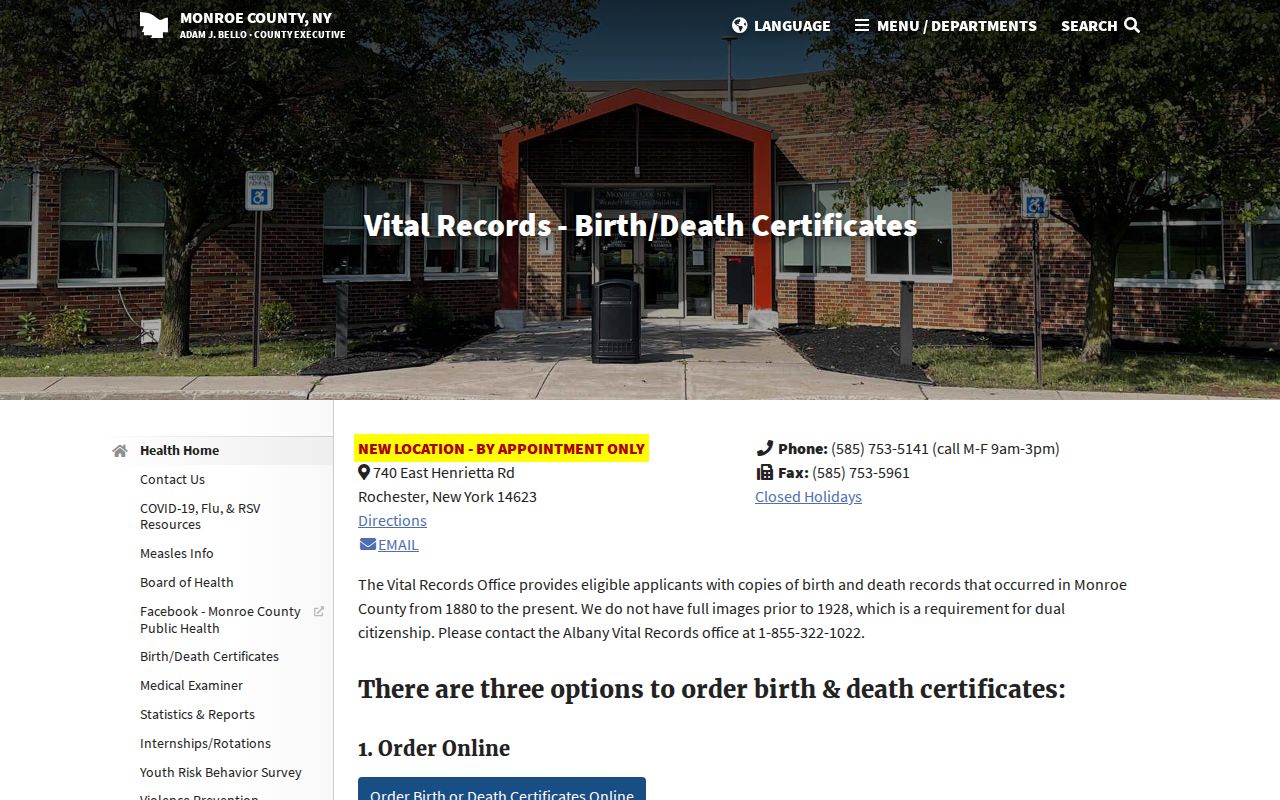
Use the service details to select the correct route before submitting an application, especially when the request concerns an older family record rather than a certified copy.
New York’s documented genealogy periods are 75 years after birth when the person is known deceased, 50 years after death, and 50 years after marriage when both spouses are known deceased. Direct-line descendants can sometimes qualify earlier with relationship and death proof. Monroe lists mail, online, and appointment routes. Certified birth or death processing can be quick when eligible, while genealogy service has a separate timetable.
Chili Voter Lookup Limits
The statewide New York Voter Lookup is a public entry route, but the static source review did not expose stable form labels or a public sample result. Do not turn that uncertainty into a claim about a person’s current status. For a location-specific question, Monroe County’s public tool is clearer about what it does and does not return.
The statewide voter lookup entry screen is a starting point for the official service.
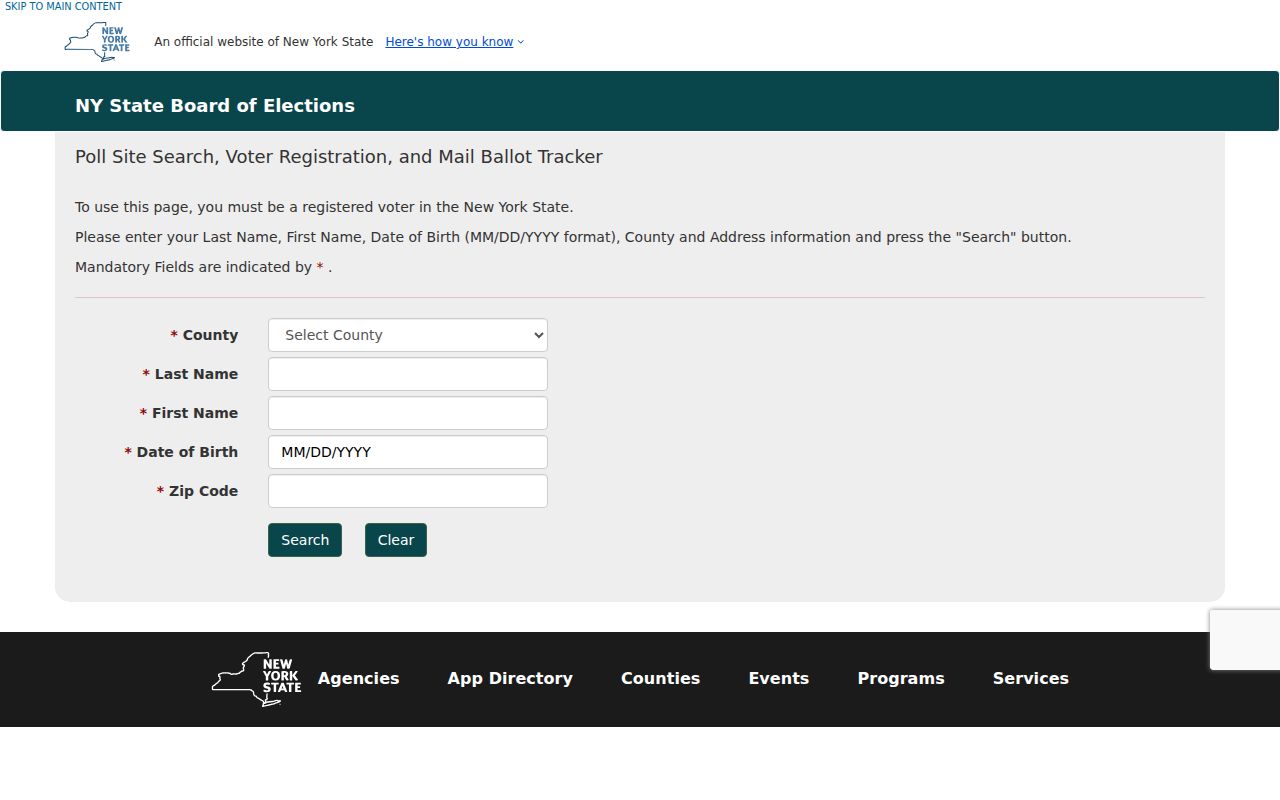
Use the live state interface for its current instructions, then keep any result distinct from a county ballot lookup or a supervised voter-file request.
Monroe County’s Lookup Ballot Info requires a street number, an autocomplete-selected street name, ZIP Code, and, when needed, party. It returns sample-ballot and Election Day polling information for the address. It does not display an individual voter’s name, registration status, date of birth, or voting history.
The official Monroe ballot lookup form shows the address and party fields required for that limited purpose.
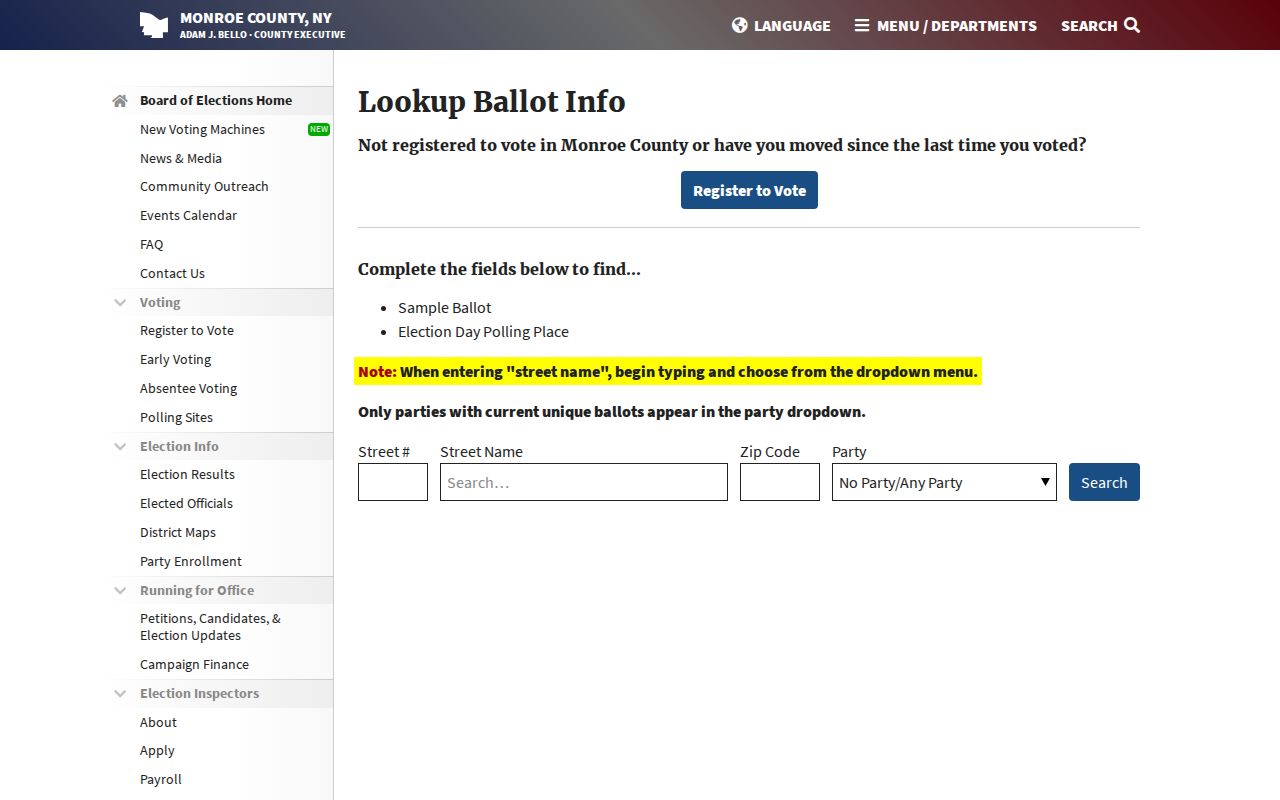
For an inspectable voter file, follow the Board of Elections process. New York law requires an election-purpose statement and withholds protected identifiers and confidential records.
Chili Resident Address Signals
A Chili parcel has more than one address field. The situs is the physical property location. The owner mailing address is where tax correspondence is sent, and it can carry a different postal city or ZIP. A legal description identifies the land through lot, subdivision, metes-and-bounds, or recorded book and page language. These fields answer different questions and should stay separate when checking a resident.
The assessment roll demonstrates the difference: a Chili property can have a Churchville mailing label, while a Town Hall address can use Rochester as its postal city. Neither postal label alone proves a move or a municipal boundary. Use the parcel number, municipality, and legal description to anchor the property, then use the mailing field only for the limited purpose the roll gives it.
Note: A parcel owner, a mailing recipient, and a person who once used an address can be three different people.
Chili Protected Resident Records
New York’s Address Confidentiality Program can provide a substitute mailing address and mail forwarding for qualifying participants. Under Executive Law §108, state and local entities must safeguard the actual location subject to statutory exceptions. A confidential voter option is also available through the state statement and local Board of Elections procedure. An address that is absent, substituted, or redacted is not an error to work around.
FOIL under Public Officers Law Article 6 is for existing agency records, not a request that an office create a person-by-person analysis. A narrow request identifies the record class, address or parcel, date range, and the office that holds it. Agencies should grant, deny, or acknowledge a request within five business days, and a denial or constructive denial has a 30-day appeal route.
Lawful personal research. Use Chili records for family history, property questions, civic research, or another legitimate personal purpose. Do not use information to stalk, harass, intimidate, or expose a protected person.
Chili Business Record Leads
The New York Department of State Corporation and Business Entity Database is a separate public record channel for corporations, LLCs, LPs, and LLPs. A result can show an entity name, organization date, jurisdiction, county, service-of-process address, registered agent, and status. A business address or agent field is a filing detail, not proof that a person lives at that address.
For an assumed name, Monroe County Clerk is the local DBA registrar under New York General Business Law §130. A Clerk request can identify the names, document type, delivery method, certification choice, and other needed details. New York UCC searches use a debtor name or filing number and have their own fee and older-name-index limits. Keep entity, DBA, and UCC results separate from personal residence evidence.
Chili Resident Lookup Fallbacks
When a public index reaches a limit, move to the custodian instead of guessing. The Monroe County Clerk accepts requests that identify an index or case number when known, record type, filing date, party or business name, property address, tax ID, and book or page. Court files can require a case number and caption. For a permit or code question, the Town’s documented fallback is a focused FOIL request by address, date, and permit category because no public result database was located.
A correction also belongs with the office that maintains the record: Chili Assessor or RPTS for property data, the Board of Elections for voter data, the clerk or court for a case index, the registrar or DOH for vital information, and DOS or the relevant agency for entity or license results. That path preserves the difference between a dated public index and the custodian’s record.