
Chili Previous Residents Sources
Past residents leave different kinds of records. A current property record is a dated ownership snapshot, not a household list. Deeds extend recorded ownership backward. Reverse directories and census schedules can show people associated with an address in an earlier period. Maps and legal descriptions help keep the search on the same parcel when a road name or postal label changes. Start with the era in question, then choose the source that actually covers it.
| Source | Years | Where | What It Shows |
|---|---|---|---|
| Chili final assessment roll | 2024, 2025, and 2026 links identified | Chili Assessor | Snapshot owner, mailing address, parcel, districts, and deed book or page |
| Online deed index | Post-1975 digital workflow | Monroe County Clerk SearchIQS | Recorded instruments and index fields; document images have a separate access level |
| Historic deed indexes | Pre-1975 | County Clerk Room 105 | Grantor and grantee index books, liber and page, then microfilm |
| House directories | 1892–1920 | Rochester Public Library | Address-to-occupant lines where the volume covers the place |
| Main directory street sections | 1922 and later | Rochester Public Library | Street or house information in the back of the main volume where present |
| Suburban directories | 1930-current guide claim | Rochester Public Library | Name and address leads; Chili coverage must be checked volume by volume |
| Federal census | Released through 1950 | Census and library tools | Household and enumeration context, subject to boundary differences |
For a recent transfer, begin with the assessment roll, property card, and recorded deed. For a household in an older period, use the closest reverse directory or street section, then compare it to the nearest released census. If the address becomes uncertain, stop repeating the modern number and switch to the legal description, parcel number, owner name, and map evidence.
Chili Past Residents Deed Chain
The deed chain is a record of ownership, not proof of every person who lived at the address. Begin with the current parcel card or Chili assessment roll. Copy the current owner, parcel ID, situs, municipality or SWIS, deed book and page, lot or subdivision, and any sales-history reference. Those fields keep the search tied to the parcel when parties have common names or the street description changes.
- Find the current owner’s purchase deed in SearchIQS by party, address, tax ID, book and page, or approximate recording date.
- Record the instrument type, parties and roles, recording date, book and page or document number, and legal description. Obtain the image through the available Clerk route when the index needs confirmation.
- Read the seller or grantor named on that deed, then look for that person or entity as a grantee in an earlier transfer.
- Repeat backward, using municipality, legal description, tax-map number, liber and page, and dates to separate same-name parties.
- When the digital trail ends, use the year and surname initial in the historic grantee or grantor books to locate the liber and page before viewing microfilm.
The direction matters. On a purchase deed, the grantor transfers the property and the grantee receives it. Repeating the seller-as-earlier-grantee step reconstructs the ownership line from one transfer to the prior acquisition. A directory, census line, or newspaper item can then add household context without changing what the deed itself proves.
- Grantor / grantee
- The grantor transfers an interest in property. The grantee receives that interest.
- Chain of title
- The sequence of recorded transfers that links one owner to prior owners of the same property.
- Legal description
- The recorded lot, subdivision, metes-and-bounds, or related land description that identifies the parcel more reliably than an old street label.
Chili Past Households After 1975
Monroe County’s historical guidance directs deed work after 1975 to the online or digital database. The County’s current SearchIQS notice distinguishes guest indexing from document-image access. A guest search can expose party name, property address, and document-type information, while original images can require a subscription or page charge. Record the index details before deciding whether the image is needed.
For past residents, the useful sequence is parcel card to deed reference, deed party to prior deed, and then a separate directory or census check for occupancy. SearchIQS is not a complete household history and its image tier should not be mistaken for the entire Clerk record. A documented reference also makes a written request more precise if an image is unavailable online.
Note: A recorded ownership transfer establishes a dated legal event, not continuous occupancy before or after that date.
Chili Past Residents Before 1975
Before 1975, the County Clerk’s route is physical research at 39 W. Main Street in Room 105. When no liber and page is known, identify the approximate transfer year, select the grantee or grantor surname initial, locate the correct index book, and retrieve the liber and page. That reference leads to the microfilm record. The Clerk’s written request route is useful when a defined item needs a copy or certification.
The Monroe County Clerk document-request form shows the record categories and identifying details used to request a defined document.
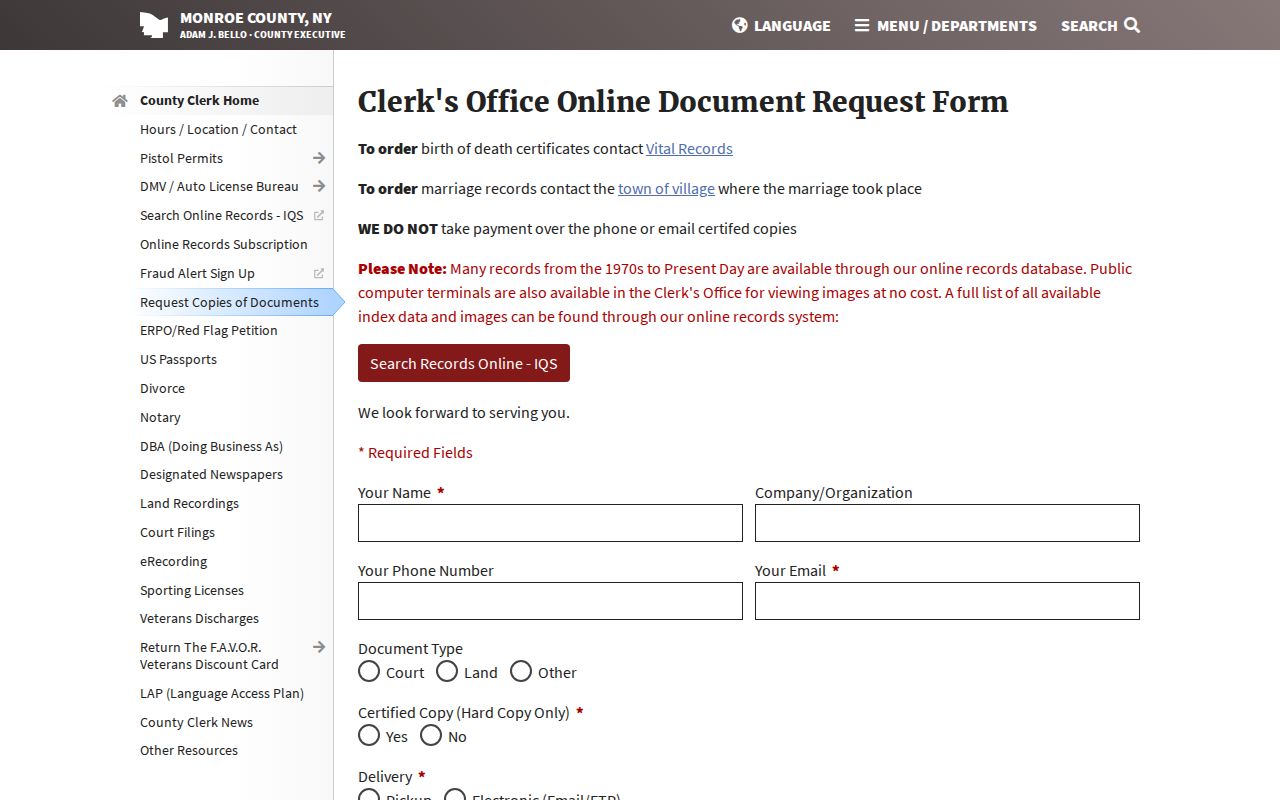
A request is strongest when it includes the record type, party or business name, property address, tax ID when known, filing date, and liber or page reference. That information lets the Clerk locate the record without guessing which past resident or parcel is intended.
Chili Clerk Terminal Comparison
Three access levels can support a Chili past-address search. Guest access can show land-index information. Online images and downloads can carry a subscription or page charge. The County Clerk’s public terminals show fuller indexing and images without the online subscription. The same deed still needs careful reading, but the access channel changes what can be reviewed before ordering a copy.
Use the online index to collect parties, dates, and references before a counter visit. At the terminal, confirm the legal description and prior-record references. For older transfers, continue from the index book and microfilm route in Room 105 rather than assuming a digital search has exhausted the history.
Practical comparison. Guest indexing, paid online images, and the free public Clerk terminal are separate access paths. Choose the path that matches the record reference and era.
Chili Previous Residents Directory Years
The regional directory shelf begins with Rochester City Directories in 1827, but the collection is Rochester-focused and does not prove that every Chili address appears in each year. Rochester House Directories run from 1892 to 1920 and provide the closest documented reverse address-to-occupant resource. From 1922, street and house material can appear in the back of the main directory. The suburban-directory guide reaches from 1930-current, with uneven town coverage.
Use the Chili City Directory collections for the collection details, then bring only the relevant year into an address history. Read the volume’s title page for its year and publisher. Save the page or scan reference, exact name spelling, residence line, abbreviation key, and any spouse or household notation. A city-directory hit is a historical lead, not an automatic statement of current residence.
The date pattern is useful on its own: 1827 begins the broad city collection, 1892–1920 supplies house directories, and 1922 moves later street information into the main book’s back section. Those are collection dates, not a promise of complete Chili coverage.
Chili Previous Residents Census Pairing
Pair an address-directory year with the nearest released federal census rather than treating the two as interchangeable. The 1950 Census is the latest generally released schedule under the federal 72-year rule. Census boundaries and postal names are not the same as Town of Chili boundaries, so read the township, county line, enumeration district, and address carefully before combining the entries.
- Normalize the street spelling, number, postal city, ZIP, and municipality for the address under study.
- Use the nearest available reverse directory or street section and transcribe each occupant exactly as printed.
- Check the alphabetical directory by surname and initials for a move, spouse notation, occupation, or another street number.
- Compare the closest released census household, its enumeration district, and address context.
- Return to the assessment roll and deed chain to distinguish an owner from another member of the household.
An enumeration district is the area assigned to a census enumerator. It helps test whether a household result belongs near the address, especially when street numbering or a postal label does not match modern use.
Chili House History Cautions
Rochester Public Library’s house-history guidance is direct: a property abstract or chain of title lists owners, times, and legal descriptions, but it does not prove an exact construction date. A Sanborn or other map can show that a structure existed or changed use by a map year. Assessment improvements, class changes, or value changes can identify a question for further research. None is a construction certificate without the underlying record.
The library offers Digital Sanborn material dated 1867–1970, FIMo fire-insurance maps dated 1875–1950, and other map resources. County materials include the 1872 Beers Atlas, county plats for 1902, 1924, 1931, and 1941, plus some suburban maps. Each map has its own coverage. Check whether the Chili parcel actually appears before using a map date in a house history.
New York towns are not required to retain assessment records longer than ten years in every situation. Older tax-roll gaps are therefore normal. No public Chili utility-customer or hookup archive was found, so request only releasable permit or inspection records from the Town.
Chili Addresses Without Numbers
No official source reviewed documented a Town of Chili-wide renumbering or renaming year. Rochester’s 1884–1885 renumbering history belongs to Rochester and cannot be applied automatically to Chili. When an old address disappears, test road-name variants, rural-route wording, postal labels, map or plat lot descriptions, owner names, tax-map numbers, and the deed’s legal description.
Postal labels can also distract from the parcel. Rochester 14624, Churchville 14428, North Chili 14514, and Scottsville 14546 appear in local official records, but a postal city does not establish a municipal boundary or a move. County Surveyor material on Great Lots and historic subdivision maps can bridge a modern address to an older land description when the street number no longer works.
Chili Previous Residents Estate Endpoints
When a deed chain reaches a death or transfer to an estate, use several sources together. Rochester Public Library’s newspaper index and Life Records index can provide notices. The Monroe County Historical Society index has probate, cemetery, church, land, court, vital, and newspaper categories. Surrogate’s Court or Clerk inquiry can then identify whether an estate, will, or administration file is public, archived, or restricted.
An obituary, probate file, or cemetery lead can connect family relationships and dates, but it does not prove that each named person lived at the address. Record the decedent name, approximate death date, county, case or file number when available, and the relevant property reference. That combination is more reliable than treating a beneficiary line as a current address record.
Lawful personal research. Use past-resident research for house history, family history, estate questions, or personal curiosity. Do not use a historical record to track, harass, or harm a living person.